Conflicts of interest and responsibility in volunteer HOA boards – what you should understand
Conflicts of interest and responsibility in volunteer HOA boards are less about rules and more about trust. This article gives a clear governance-based understanding of when conflicts matter. And why responsibility is always collective.
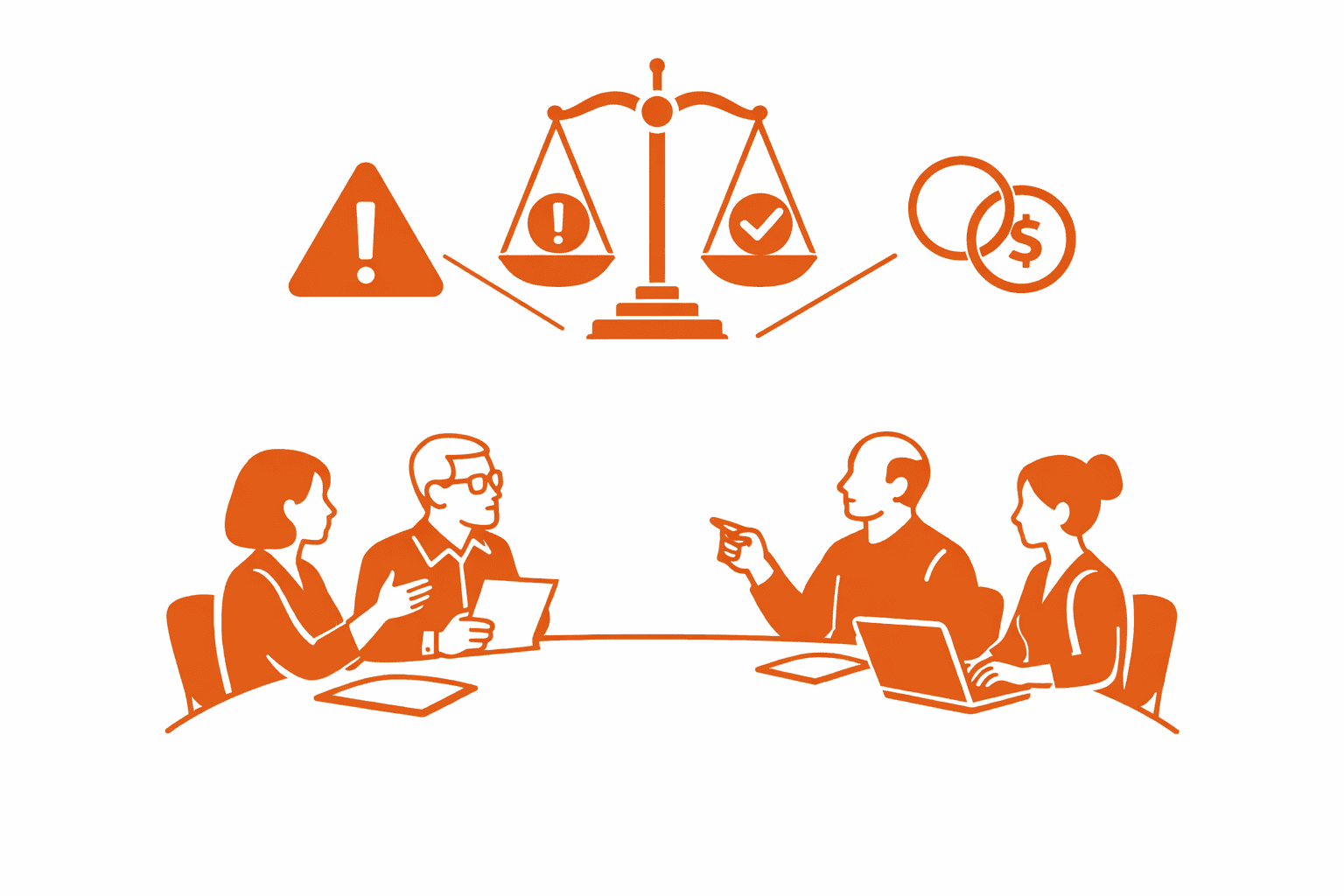
Conflicts of interest and responsibility in volunteer HOA boards sound like something from a legal handbook. That’s unfortunate, because in practice they are far more about common sense, openness, and trust than about rules. And that’s exactly why the topic deserves to be understood correctly.
In volunteer boards, relationships are close. You’re neighbors. You know each other. Some have served for years. Others are new and still finding their footing. In that reality, conflicts of interest don’t appear as theoretical problems, but as very concrete questions:
Can we explain this decision in a way that makes everyone in the community feel comfortable?
If the answer is no, there is a governance problem — even if no one has done anything wrong.
(Read more about what a conflict of interest means in our HOA glossary.)
What conflicts of interest are really about (without legal language)
Conflicts of interest are often misunderstood as something that only matters when a rule is broken. From a governance perspective, that’s wrong.
Conflicts of interest are not primarily about legality.
They are about legitimacy.
The question is not only: Am I allowed to take part in this decision?
The question is also: Should I?
When a board member has a personal interest in a matter — financial, relational, or practical — there is a risk of mistrust. Not necessarily because the decision is wrong, but because it can be perceived as opaque.
And perception matters just as much as intention.
Good governance begins when the board itself identifies these situations — before anyone outside the board does.
Typical situations where conflicts of interest arise
In volunteer HOA boards, conflicts of interest rarely appear in dramatic cases. They show up in everyday decisions.
A board member may be a contractor or have a relationship with a vendor. It could be a neighbor, a relative, or a former business partner. The intention may be good, the price fair, and the work solid. Still, the board faces a choice:
Should the relationship be handled openly — and should the member step out of the decision?
Another common example is decisions that directly affect one’s own home. New windows. Balconies. Changes to shared areas. The personal interest is obvious. Even if many residents benefit as well. In these cases, it’s not enough to “vote like everyone else.” Awareness of one’s role and transparency are essential.
The third situation that often creates problems is lack of openness about relationships. Not because anyone wants to hide something, but because people forget that others don’t share the same context. When relationships only become known after a decision, mistrust arises.
And mistrust rarely stays limited to one person.
It affects the entire board.
When should you step out? A practical rule of thumb
Boards often ask for a clear line: When does a conflict of interest actually apply?
Here, the governance answer is more useful than a legal one.
You should consider stepping out of a decision when:
- you have a special personal interest in the outcome
- you have a relationship that others could reasonably question
- you cannot calmly explain your participation afterward
This is not about guilt.
It’s about protecting the decision — and the board — from doubt.
Stepping out is not a sign of weakness.
It’s a sign of maturity.
And most importantly: it should be completely undramatic.
A board with healthy governance has a culture where someone can say,
“This one you’ll have to take without me,” and where that is respected.
Responsibility in the board is always collective
One of the most widespread misunderstandings in volunteer boards is that responsibility follows tasks.
That the treasurer “has responsibility for finances.”
That the president “has responsibility for decisions.”
That a committee “has responsibility for a project.”
From a governance perspective, this is incorrect.
Responsibility is collective.
That doesn’t mean everyone does everything.
It means everyone stands behind the decisions. Even when tasks are delegated. Even when responsibilities are distributed. Even when you weren’t deeply involved in the details.
That’s why conflicts of interest and responsibility are so closely linked.
If a conflicted situation affects a decision, it affects the entire board — not just the person with the interest.
This is precisely why openness matters.
Not to assign blame — but to protect the community.
Poor governance creates conflicts — not bad people
When conflicts of interest aren’t handled clearly, conflicts rarely arise immediately. They simmer.
Residents begin to ask questions.
New board members don’t understand the background.
Old decisions become objects of suspicion.
This is where conflicts often grow — not because anyone acted in bad faith, but because the governance framework was too weak.
And once trust is challenged, even good decisions become hard to defend.
Good governance does the opposite.
It makes decisions robust — even when they are questioned later.
Documentation is the best ally of good governance
Conflicts of interest and responsibility don’t live only in dialogue.
They live in documentation.
When relationships, considerations, and decisions are recorded, governance becomes visible. This doesn’t require long explanations or legal notes. It requires short, clear minutes that show:
- who participated in the decision
- whether anyone stepped out — and why
- what the basis for the decision was
Often, that’s enough to remove doubt.
And it makes it far easier for new board members to understand how and why earlier decisions were made.
Governance is the ability to explain decisions later
The best rule of thumb for conflicts of interest and responsibility is simple:
Can we explain this decision calmly and openly — even two years from now?
If the answer is yes, governance is likely healthy.
If the answer is no, the board should pause.
Good governance is not about avoiding mistakes.
It’s about being able to stand behind your choices — even when they are challenged.
That’s what creates trust among residents.
And that’s what makes board work sustainable over time.
FAQ about conflict of interest and responsibility
- What is a conflict of interest in volunteer HOA boards? A conflict of interest concerns trust and perceived fairness. It arises when a board member has a personal interest that may influence — or be perceived to influence — a decision.
- Should you always step out if you are in doubt? Not necessarily, but openness is crucial. If reasonable doubt can arise about your role, stepping out is often the safest way to protect the decision.
- Who carries responsibility in the board? Responsibility is collective. Even when tasks are divided, the board as a whole stands behind the decisions.
- How do you avoid conflicts around conflicts of interest? Through early openness, clear decision processes, and simple documentation. Governance prevents conflicts before they arise.